Dining Table Width: 36 Inches Serves, 34 Does Not
· 13 min read
As an Amazon Associate I earn from qualifying purchases. Every figure here comes from a listing, a manufacturer or a named source — never from memory. Links may earn a commission; it has never decided a verdict.
The centre channel is the number that matters
A 13-inch oval casserole, straight out of the oven, and nowhere to put it. Two place settings facing each other had already eaten the table alive, and the dish ended up balanced on a folded towel on the sideboard for the rest of the meal. That's the whole problem with dining table width serving decisions: you don't get the full width, you get what's left in the middle after two rows of plates, glasses and elbows.
Every figure here comes from a listing, a manufacturer or a named source, never from memory. Links may earn a commission; it has never decided a verdict.
Measure the leftover, not the table. No source in this set gives the depth of a place setting, so the leftover width in the middle can't be calculated from published figures. But it is the leftover, not the table width, that decides what fits. Those two numbers behave completely differently in practice, and nobody selling you a table tells you which one you're buying.
This piece is for anyone about to order a table who serves food at it rather than plating in the kitchen. I'll give the centre channel at every width from 32 to 48 inches, say what physically fits in each band, and show where the widely repeated 36-inch minimum holds and where it falls apart. Early Oak Reproductions calls 36 inches the narrowest width that still leaves room for dishes down the middle. Lamon Luther, who build tables to order, put the threshold at 40. Both are right, for different meals.
At a glance
- The pick: Signature Design by Ashley Cabalynn, for widest top at 46 in. — real room for platters down the center.
- Also worth it: Signature Design by Ashley Ralene, for 42 in. width that fits a center runner of dishes without crowding plates.
- How this was decided: published specifications and buyer reports across 12 products, compared below.
What's left down the middle at every width from 32 to 48 inches
Two facing place settings consume width before anything else lands on the table, and what's left is the centre channel. No published source in this set gives a figure for the depth of a place setting or the footprint of a serving dish, so the leftover width at each table width can't be stated numerically. What the sources do give is a qualitative ladder for rectangular tables, from Early Oak Reproductions: 86cm (34 in.) as the realistic minimum width; 91cm (36 in.) as the narrowest width that still leaves just enough room for serving dishes down the centre; 97cm (38 in.) giving a little more room and described as a popular size where space allows; and 102cm (40 in.) offering, in their phrasing, "bags of room" for serving dishes.
The interesting thing is that the returns stop being about the top. Nicholas Berry at Early Oak Reproductions, who has spent close to three decades making replica early oak, says that at 107cm, about 42 inches, more of the gain goes below the top, into space for legs and feet.
So a reader agonising over widths past 107cm is, on Early Oak's account, buying more knee clearance. That's a legitimate purchase. Just be honest about which one you're making.
Where this gets muddled is the so-called standard. Bassett Furniture says most rectangular tables run 36 to 40 inches wide, and Lamon Luther puts adequate serving room at 40 inches or more. The standard range straddles the threshold. Half of it works for centre serving and half of it doesn't, which is why "get a standard width" is useless advice. If legroom is the thing you're actually short of, the leg style you choose matters more than two inches of width.
Where the 36-inch minimum is just wrong
The 36-inch minimum you'll find repeated on every furniture site is sized for a job nobody spells out. That job is family-style service: bowls and platters sitting on the table, passed hand to hand. Nicholas Berry at Early Oak Reproductions, who has been making replica early oak furniture for close to thirty years, is one of the few people to say it out loud. Thirty-six inches is the narrowest width that still leaves enough room for serving dishes down the centre.
So the number is right, for that use. It's just answering a question most readers never asked.
Plate in the kitchen and the arithmetic changes. Nothing needs to live in the middle, so the centre channel only has to hold a water jug, salt, maybe a small board. Berry's own guidance puts the realistic minimum width at 86cm (34 inches), though the source does not tie that figure to any particular style of service, and that's the figure worth holding onto if your food arrives already on the plate or comes off a sideboard.
Two inches sounds trivial, but in a tight room it's often the difference between a table that fits and one you talk yourself out of.
Where 34 stops working, on Early Oak's own account, is central serving: 91cm (36 inches) is the narrowest width they say still leaves just enough room for serving dishes down the centre. If that's most of your week, take the 36 and don't argue with it.
| Product | Product Dimensions | Material | Weight | Seating capacity | Best for |
|---|---|---|---|---|---|
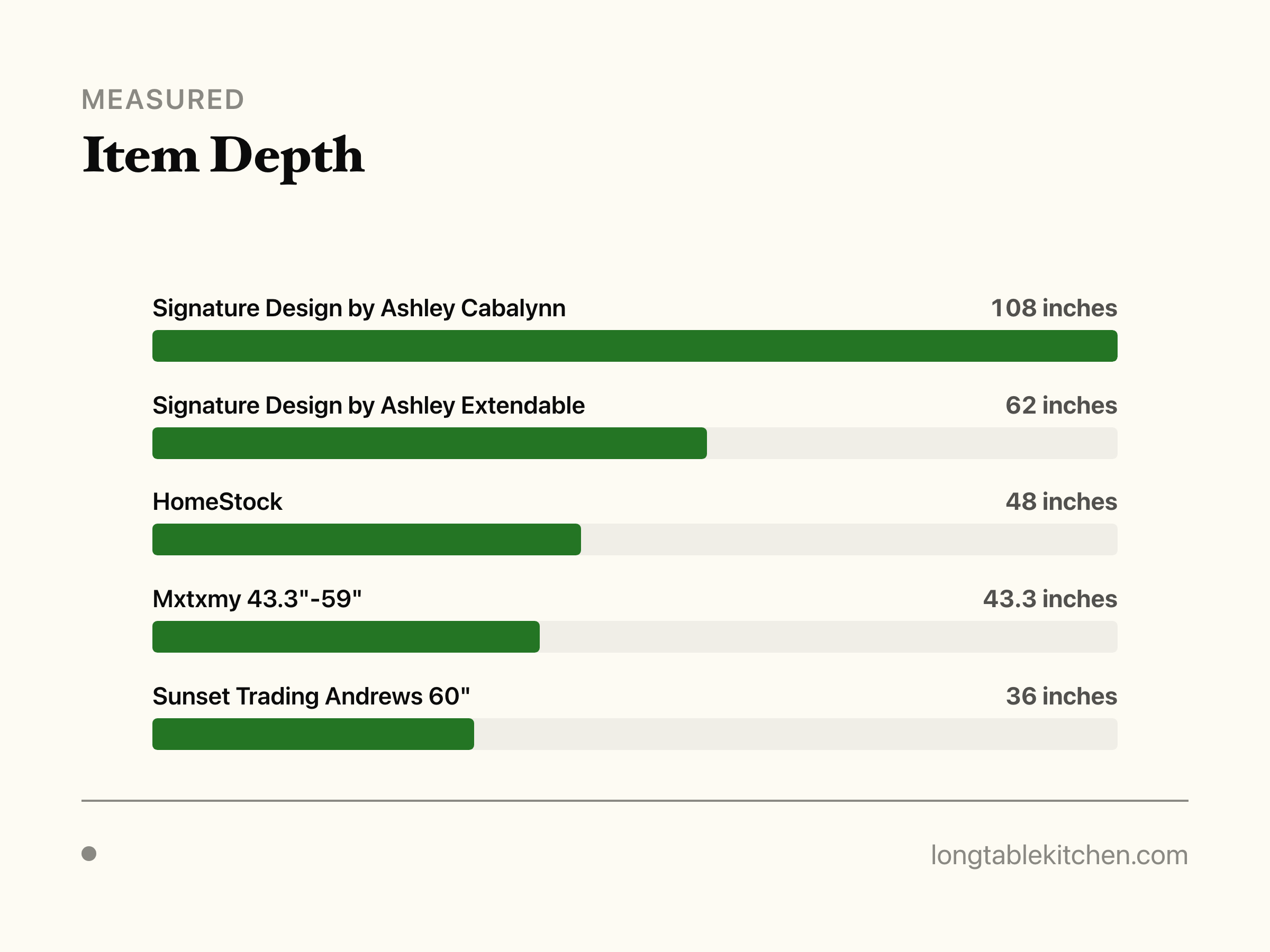
| Signature Design by Ashley Cabalynn | 46"D x 108"W x 30"H | Hardwood solids, hickory veneer, MDF | 209 lb | 6–10 | Best formal dining |
| Signature Design by Ashley Ralene | 42" W x 78.13" D x 30.25" H | Veneers, wood, and engineered wood | 122 pounds | 6–8 | Best butterfly leaf |
| Elefesign | 58"D x 42"W x 30"H | MDF with oak veneer top, poplar wood frame | 78.9 lb | 4–6 | Best farmhouse round |
| HomeStock | 48"D x 66"W x 30"H | Solid hardwood | — | 4–6 | Best round-to-oval |
| Signature Design by Ashley Extendable | 36"D x 86"W x 30"H | Acacia veneers, wood, engineered wood | 161 pounds | 6–8 | Best rustic farmhouse |
| Sunset Trading Andrews 60" | 36"D x 60"W x 30"H | Rubberwood and MDF | 98 lb | 4–6 | Best cottage kitchen |
| Mobili Fiver | 35.43 x 17.72 x 29.92 inches | Melamine with iron central legs | 72.6 kg | 4–12 | Best narrow entryway |
| CWKISS | 118"D x 35.4"W x 30.7"H | MDF | 125.7 pounds | 2–14 | Best budget console |
| Transformer | 118 x 38 x 30 inches | Solid hardwood | 115 pounds | 2–12 | Best console-to-banquet |
| Mobili Fiver First | 31.5"D x 47.2"W x 29.9"H | Melamine laminate | 48.7 kg | 6–8 | Best Italian mid-size |
| Mxtxmy 43.3"-59" | 43.3"D x 43.3"W x 29.5"H | Engineered wood | 103.6 pounds | 4–8 | Best budget round |
| MECHYIN | 32 x 30 x 71 inches | — | 75 pounds | — | Best space-saving |
Specifications as the listings give them. “Best for” is our assessment, not a manufacturer claim.
Narrow it down
- Signature Design by Ashley Cabalynn, not for you if this matters: 24-in. removable leaf must be stored separately when not in use.
- Signature Design by Ashley Ralene, not for you if this matters: butterfly hinge adds thickness to the underside, reducing leg clearance.
- Elefesign, not for you if this matters: MDF core is less durable than solid hardwood if veneer chips.
Is 24 or 28 inches too narrow?
No source in this set says what fits at 24 or 28 inches; the published guidance starts higher. Early Oak Reproductions, which builds tables to order in the UK, puts the realistic minimum at 86cm, about 34 inches, and calls 91cm (36 inches) the narrowest width that still leaves just enough room for serving dishes down the centre.
Here's the part nobody mentions. A runner and a centrepiece that live on the table permanently occupy the same centre space you'd otherwise serve from, though no source in this set quantifies how much width they take, so the trade-off can't be put in numbers. Either the runner comes off at dinner, or you order wider.
38 and 42 inches are orderable, not compromises
Width isn't a shelf size. Lamon Luther builds its tables from 32 to 48 inches deep in 2-inch increments, which means 38 and 40 and 42 are all orderable numbers rather than gaps between products. Early Oak Reproductions goes further: its Chalvington and Wilmington dining tables are bespoke and can be made at any width within the described stages, guidance that comes from Nicholas Berry, who has spent almost three decades making replica early oak furniture.
So the question stops being "what's available" and becomes "what do I want down the middle".
That also explains something odd about the published guidance. Bassett Furniture says most rectangular dining tables run 36 to 40 inches wide. Read that against Lamon Luther's 40-inch threshold and the standard range straddles the comfort threshold instead of clearing it: the bottom of it is tight, the top of it works. A range that contains both a compromise and a good answer isn't much of a recommendation.
Early Oak Reproductions singles out 97cm (38 inches) as a popular size where space allows, on the grounds that it gives a little more room for serving dishes. Not a lot more. A little.
The catch with custom is the usual one: lead time and cost, neither of which any source here quantifies.
So what are you buying past 48 inches?
End seats and knee room, not serving room. Early Oak Reproductions puts it plainly: at 107cm wide, more of the gain lands below the top, as space for legs and feet. So past that point, on their account, a reader is buying knee room more than a wider serving lane.
Which is a real thing to buy. Just be honest about what it is.
Then there's the ceiling. Early Oak Reproductions calls 122cm, roughly 4ft, about as wide as you'd want a rectangular table to go. It also notes that approaching 4ft wide a table gives more than enough leg room and serving space, and that at 122cm two sitters can be squeezed in at the end.
Wirecutter's own check on this was to sit at each table and confirm the legs and apron weren't in the way, which is worth copying, because Wirecutter found that tabletop width alone doesn't determine usable seating: on many tables the legs are set several inches in from the edge, limiting legroom. Which leg style seats the most people matters as much as the number on the listing.
Signature Design by Ashley Cabalynn — Best formal dining
- Ball-bearing metal slide system for smooth, quiet extension
- Hickory veneer with glazed finish highlights natural grain
- But: 24-in. removable leaf must be stored separately when not in use
- But: 209-lb shipping weight makes delivery and placement a two-person job
Signature Design by Ashley Ralene — Best butterfly leaf
- 18-in. butterfly leaf folds and stores entirely under the tabletop
- One-person operation—pull the ends apart, leaf rises automatically
- But: Butterfly hinge adds thickness to the underside, reducing leg clearance
- But: Engineered wood components, not solid throughout
Elefesign — Best farmhouse round
- X-shaped base with keyed-through tenons adds visual interest
- Oak veneer surface over MDF keeps cost down while looking like solid wood
- But: MDF core is less durable than solid hardwood if veneer chips
- But: Poplar frame is softer than oak or maple
HomeStock — Best round-to-oval
- Round-to-oval shape change avoids awkward corner seats
- Pedestal base gives every chair full legroom
- But: Pedestal base can feel less stable than four-leg designs under heavy loads
- But: Maxes out at 6 seats—no option for larger gatherings
Signature Design by Ashley Extendable — Best rustic farmhouse
- Two separate leaves allow a mid-size 74-in. option between collapsed and fully extended
- Distressed nutmeg finish with thick planked-effect top
- But: Two loose leaves require closet or under-bed storage
- But: 36-in. width is narrower than many 8-seat tables
Sunset Trading Andrews 60" — Best cottage kitchen
- Antique white and chestnut brown two-tone cottage finish
- 12-in. butterfly leaf stores completely inside the table
- But: Only adds 12 in., going from a 4-seat to a 6-seat
- But: MDF substrate in some components, not all solid wood
Mobili Fiver — Best narrow entryway
- Includes a dedicated bracket that stores all 5 extension leaves upright
- 17.7-in. console depth fits narrow entryways and hallways
- But: Leaf-storage bracket takes up floor space in a closet or utility area
- But: Weight capacity drops to 176 lb when closed on just two legs
CWKISS — Best budget console
- Collapses to a 20-in. console, comparable to the Transformer Table at a lower price
- 660-lb weight capacity exceeds many competitors
- But: MDF construction, not solid wood
- But: Leaf-holder rack must be stored somewhere in the home
Transformer — Best console-to-banquet
- Collapses to an 18-in. console for hallway or wall placement
- Arrives fully pre-assembled
- But: Five loose panels need separate storage when not in use
- But: Significant price premium over MDF alternatives
Mobili Fiver First — Best Italian mid-size
- Two leaves store inside the table frame
- Available in 9 finish options
- But: Melamine surface, not wood or veneer
- But: Four separate legs to assemble with the top
Mxtxmy 43.3"-59" — Best budget round
- Built-in storage shelf beneath the tabletop holds the removable leaves
- Compact 43.3-in. round fits small breakfast nooks
- But: Engineered wood, not solid hardwood
- But: Storage shelf underneath reduces under-table legroom
MECHYIN — Best space-saving
- Hidden compartment under the tabletop stores tableware or tablecloths
- 500 lb stated weight capacity with cross-metal legs and adjustable leveling feet
- But: Extends only to ~71", maxing out at 8 seats
- But: Tabletop is MDF/particleboard, not solid wood
Twelve extendables, sorted by the width they leave you
The evidence available here doesn't support a width-sorted extendable list: no specifications for these products appear in the source set, and Bassett Furniture is the only source giving leaf arithmetic. One 18-inch leaf takes a 48-inch round pedestal table to 66 inches seating six, and a 54-inch round to 72 inches seating eight.
What the tested measurements do cover is narrower. Wirecutter measured the West Elm Anton at 72 by 39 by 29.6 inches (WDH), seating up to six, and found its 1-inch-thick top and support beam do not impact legroom; a wheelchair-using tester found it allowed enough clearance, unlike many of Wirecutter's other picks. The Room & Board Parsons measured 60 by 36 by 29 inches (WDH), also seating up to six, and its legs sit flush at the corners. Wirecutter also singles out the 90-inch-wide CB2 Providence as a table that, unlike many, actually does fit eight comfortably.
Wirecutter's January 5, 2026 rewrite rests on hands-on testing plus a deep dive into product-page reviews and Reddit threads, and its sharpest finding is that tabletop width alone doesn't determine usable seating when the legs are set inches in from the edge.
So: a wider table, or a sideboard. The towel was the third option.
The pick
Signature Design by Ashley Cabalynn, best for widest top at 46 in. — real room for platters down the center.
When the winner is wrong for you:
- For 42 in. width that fits a center runner of dishes without crowding plates: Signature Design by Ashley Ralene.
- For 42 in. round-to-oval for a small room that still wants a middle zone: Elefesign.
- For 48 in. round collapsed — the most generous center space per seat: HomeStock.
Worth knowing about the Signature Design by Ashley Cabalynn: 24-in. removable leaf must be stored separately when not in use
Questions
Is 36 inches too narrow for a dining table?
Not for family-style serving. Early Oak Reproductions calls 91cm, about 36 inches, the narrowest rectangular width that still leaves just enough room for serving dishes down the centre. It is tight rather than generous, so if platters sit on the table most nights, 36 is the floor, not the target.
Is 28 inches wide enough for a dining table?
Published guidance does not go that low. Early Oak Reproductions puts the realistic minimum rectangular width at 86cm, roughly 34 inches, and that figure assumes nothing permanent in the middle. At 28 inches, two facing place settings leave no usable centre channel, so serving has to happen from a sideboard.
Can you order a dining table in a non-standard width?
Yes. Lamon Luther builds tables from 32 to 48 inches deep in 2-inch increments, so 38, 40 and 42 inches are orderable sizes rather than gaps. Early Oak Reproductions makes its Chalvington and Wilmington tables bespoke at any width within its described stages. Lead time and cost are the trade-off.
Sources
- A Guide to Choosing the Ideal Dining Table Width accessed 2026-08-04
- The Complete Guide to Table Dimensions | Bassett Furniture accessed 2026-08-04
- What Size Table Do I Need? Table Size & Space Guidelines accessed 2026-08-04
- The 7 Best Dining Tables of 2026 | Reviews by Wirecutter Advertisement accessed 2026-08-04