
How Deep Are Sideboard Drawers, Really?
· 9 min read
As an Amazon Associate I earn from qualifying purchases. Every figure here comes from a listing, a manufacturer or a named source — never from memory. Links may earn a commission; it has never decided a verdict.
The inches you actually get, not the inches on the listing
Sideboard drawer capacity is set by the interior figure, not the exterior one. No source publishes usable drawer-box depth for a sideboard. The only documented subtractions (carcass, slide clearance, drawer front overlay) come from kitchen cabinetry, where MKE Cabinetry computes interior depth as box depth minus one inch and side-mount slides consume about half an inch per side. The recommended sideboard depth of 16 to 20 inches is the ceiling on how deep any drawer inside one can be.
Every figure here comes from a listing, a manufacturer or a named source, never from memory. Links may earn a commission; it has never decided a verdict.
The consequence is immediate, though no source converts sideboard drawer dimensions into contents: a drawer inside a 16-inch-deep case has less than 16 inches to work with, so large chargers and platters are near or past the limit.
For context on the exterior figures, Belleze puts sideboards at:
- standard, 16 to 20 inches deep
- compact, 14 to 18
- large, 18 to 24
- entryway or hallway, 12 to 16
No source publishes the corresponding usable drawer box depths.
Why does this matter now? Shoppers compare exterior dimensions across listings, and almost none of those listings publishes the interior. What follows works from each option's published numbers, so you can decide before the flat pack arrives rather than after.
What the cabinet trade already worked out
The kitchen cabinet trade has documented this properly. CKF puts usable drawer box depth inside a 24 inch base cabinet at only 20 to 21 inches, citing Aristokraft, KraftMaid and Merillat specs. MKE Cabinetry computes interior depth as box depth minus an inch flat. Side-mount slides like the Accuride 3832E eat about half an inch per side; undermount hardware needs only a quarter. On a 24 inch opening, CKF's arithmetic gives a box roughly 23 inches wide behind a front roughly 25 inches wide.
Two inches, between the face you see and the space you get. Sideboards are shallower than base cabinets to begin with, and KCMA puts standard base cabinet depth at 24 inches, though no source carries the subtraction across to case goods. For the width side of this problem, sideboard dimensions against your room covers the footprint.
At a glance
- The pick: Aitjunz, for it is the right answer for someone who wants nearly all of a sideboard's capacity in drawers rather than behind doors, with stated internal drawer dimensions to plan flatware trays and folded linens around.
- Also worth it: IAISRO Fluted, for it is the right answer when the drawers need to swallow bulky items — rolled table linens, serving utensils, trivets — rather than hold shallow cutlery trays.
- How this was decided: published specifications and buyer reports across 7 products, compared below.
How many place settings, tablecloths and napkins fit?
No source in the evidence reviewed converts any sideboard drawer's dimensions into place settings, trays or serving pieces.
What the sources do document is the general division of labour, not counts: guides from Radiant, Hompkin and Sangiacomo all assign drawers to small items (cutlery, flatware, linens, personal items) and reserve cabinets with adjustable shelves for serving platters, dinnerware, bottles and bulky goods. On drawer heights, CKF's drawer sizing guide puts the top drawer of a typical three-drawer kitchen base at 4 to 5 inches and the middle at 6 to 8, and KraftMaid documents bands of about 4, 7 and 10 inches. Those are kitchen figures. No source states what height a sideboard drawer needs for linens, chargers or candlesticks.
The fold math that rules things out
No source in the evidence reviewed gives folded tablecloth dimensions or matches them against sideboard drawer sizes; the sources say only that linens belong in drawers and bulky items behind doors on adjustable shelves. If the cloth sizes themselves are the open question, the tablecloth size and drop length guide works through the stock-size mismatch.
Weight is the limit nobody prints
No source gives a per-drawer weight rating for any sideboard. The only load figures available are hardware and whole-case ratings: Blum rates its MOVENTO slide at 170 lbs for wide, high and deep drawer applications, a useful benchmark for heavy-load hardware. Nothing in the sources says which slides sideboard makers actually fit, or how many pounds of flatware, linens or bottles one sideboard drawer will take.
On failure, the only account available is a retailer's. The Curated by Hower guide asserts that drawers which bind or sag, and particleboard bottoms held on with industrial staples, are the first part of a sideboard to fail. No owner reports or buyer-side failure accounts were found to support it.
Whole-case ratings tell the same story from the other end. Povison rates one sintered-stone-top, MDF-body sideboard at 150 lbs total.
The sizing guidance in these guides points the same way: drawers for small items like cutlery, flatware and linens, cabinets with adjustable shelves for platters, dinnerware and bottles.
| Product | Product Dimensions | Material | Item Weight | Additional Features | Best for |
|---|---|---|---|---|---|
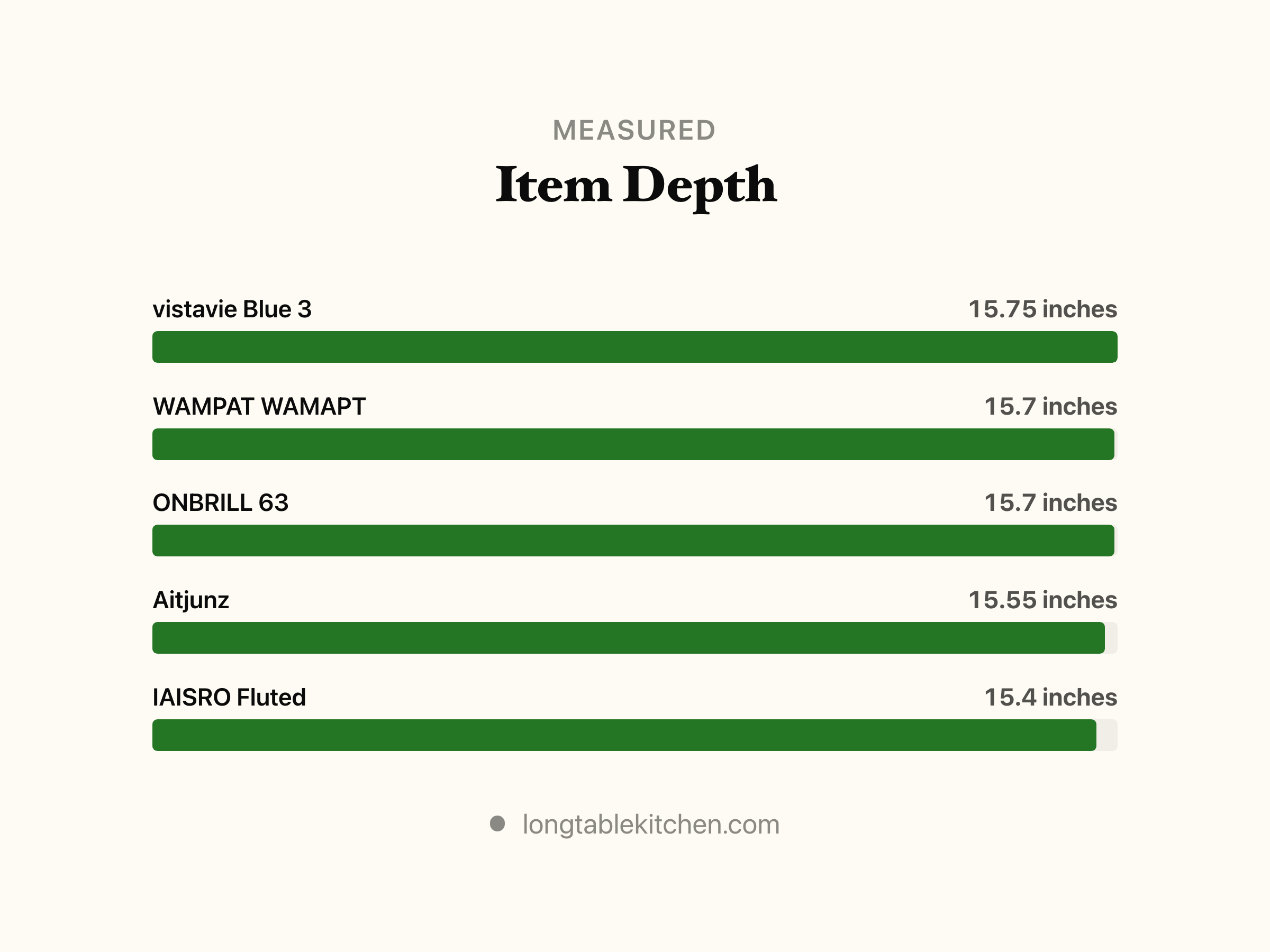
| Aitjunz | 15.55"D x 47.24"W x 33.85"H | Wood | — | 7 Drawers, Spacious Tabletop | Best all-drawer storage |
| IAISRO Fluted | 15.4"D x 55.1"W x 39.4"H | Engineered Wood | 50 pounds | Adjustable Shelf, Anti-Tipping, Removable Shelf | Best deep drawers |
| Bifins 55inch | 13.78"D x 55"W x 31.5"H | Engineered Wood | 68 pounds | Adjustable Shelf, curved edge, drawer | Best shallow depth |
| vistavie Blue 3 Doors | 15.75"D x 47.24"W x 35.55"H | Engineered Wood | 89.5 pounds | Easy Assemble, adjustable layer | Best compact footprint |
| WAMPAT WAMAPT | 15.7"D x 67.7"W x 30.9"H | Wood | — | Unlit | Best splittable unit |
| GRUSIGN | 15.1"D x 55.1"W x 31.8"H | Engineered wood | 99.9 pounds | Wheeled | Best shelf capacity |
| ONBRILL 63 | 15.7"D x 63"W x 30"H | Engineered Wood | 99.8 pounds | Entway Table, Kitchen Storage, Sofa Tbale, TV Stand, Tea & Coffee Bar | Best glass display |
Specifications as the listings give them. “Best for” is our assessment, not a manufacturer claim.
Narrow it down
- Aitjunz, not for you if this matters: drawers rated to only 20 lbs each, so heavy stacked china is out.
- IAISRO Fluted, not for you if this matters: only two drawers, so flatware, linens and serving pieces have to share.
- Bifins 55inch, not for you if this matters: 13.78" depth limits how much a dinner plate stack or full charger can lie flat.
34–38 or 36–40? Test it against your counter, not your eye
The bands don't agree. Hompkin, in a guide dated 15 June 2026, puts dining buffet height at 34 to 38 inches, on the reasoning that it sits close to standard table height and serves comfortably. Curated by Hower gives 36 to 40. Both are describing the same furniture. Neither band tells you whether the drawer works.
The sources offer only their own reasoning on height: Hompkin's stated rationale for 34 to 38 inches is that it is comfortable for serving and close to standard table height, and Povison describes the buffet as sized to level with a countertop or tabletop for serving. No source sets out a counter-height test for drawer access.

No product heights or drawer positions for the pieces in this group are documented in the evidence reviewed.
If you care about the relationship to the table, buffet height set 3-6 inches above your table is the number to work from instead. Pick which of the two you're actually optimising: reach, or proportion.
Three interior layouts against three loads
Curated by Hower splits the layouts cleanly by interior: sideboards are mostly cabinets, buffets are drawers over cabinets, media consoles are open shelves with cabinets. No source scores those layouts against particular loads.
Nothing in the sources states what interior height flatware, linens or platters require in a sideboard. KraftMaid's 4, 7 and 10-inch bands are kitchen figures.
The all-cabinet layout is what Architectural Digest lists in the Castelry Ariel Sideboard: three compartments with adjustable shelves and no drawers.
The mixed layout covers the most ground, which is why Hompkin's 2026 buying guide names drawers over cabinets as the arrangement that handles the widest set of uses. West Elm's 60-inch Ellington Buffet is the reference shape: Architectural Digest describes three drawers plus two doors concealing adjustable shelves.
Drawer count is a styling decision, not a capacity standard. Fufu Gaga lists a 63-inch piece with nine drawers, marketed as both dresser and storage sideboard at $199.99 down from $328.99, and a 59-inch with six drawers at $269.99.
When the sideboard has no drawers at all
Plenty of sideboards have no drawers, and the word never promised any. Curated by Hower's buying guide describes a sideboard as a long, low cabinet roughly 30 to 36 inches tall that almost always has cabinet doors and only sometimes a row of drawers across the top. No source reconciles the sideboard, buffet and credenza definitions, and no standards body is cited for any of them. Architectural Digest's roundup lists the Castelry Ariel with three shelved compartments and no drawer at all, and the Joon Loloi Wabash with two adjustable shelves and cord management.
So the storage has to go elsewhere. The sources agree that doors take what stacks or stands, dinnerware, platters and bottles, on adjustable shelves. None says where flatware and linens should go in a piece with no drawers.
No specifications for the ONBRILL or GRUSIGN cabinets appear in the evidence reviewed.
No source addresses retrofitting a pull-out into a sideboard, or the clearances it would require.
Which one for which room
The evidence reviewed contains no depths, drawer dimensions or interior heights for the seven pieces in this group, so no per-room recommendation can be drawn from them. What the sources do support is the general division:
- drawers for cutlery and linens
- cabinets with adjustable shelves for platters, dinnerware and bottles
- a narrow sideboard under 16 inches deep to sit flush without blocking foot traffic
- modular units, three 32.5-inch Belleze Jagger cases spanning about 97.5 inches, where one long case won't work
Every figure here comes from published guides and listings, not from units anyone opened. No owner reports or buyer-side failure accounts were found. Belleze recommends 30 inches of walking clearance in front of a sideboard, and Curated by Hower, a retailer guide unsupported on this point by any buyer-side source, asserts that customers always chose one size smaller than they needed. Measure both before you order.
The pick
Aitjunz, best for it is the right answer for someone who wants nearly all of a sideboard's capacity in drawers rather than behind doors, with stated internal drawer dimensions to plan flatware trays and folded linens around.
When the winner is wrong for you:
- For it is the right answer when the drawers need to swallow bulky items — rolled table linens, serving utensils, trivets — rather than hold shallow cutlery trays: IAISRO Fluted.
- For it is the right answer for a shallow wall where the sideboard cannot project into a walkway but still needs a three-drawer flatware bank: Bifins 55inch.
- For it is the right answer for a compact dining room that still wants three drawers and three separate door bays under 48 inches of width: vistavie Blue 3 Doors.
Worth knowing about the Aitjunz: drawers rated to only 20 lbs each, so heavy stacked china is out
Questions
How deep are sideboard drawers, really?
No maker publishes usable drawer box depth for sideboards. Exterior case depth is typically 16 to 20 inches for a standard piece, and cabinet-trade math subtracts about an inch for the carcass plus roughly half an inch per side for side-mount slides, so the interior is meaningfully shallower than the listing.
How much weight can a sideboard drawer hold?
No sideboard maker publishes a per-drawer rating. Only hardware and whole-case figures exist: Blum rates its MOVENTO slide at 170 lbs for wide, deep drawers, while Povison rates one sintered-stone-top MDF sideboard at 150 lbs total. Which slides a given sideboard uses is rarely stated.
Where do you store large serving platters if the drawers are too shallow?
Behind the doors. Guides from Radiant, Hompkin and Sangiacomo consistently assign drawers to small items like cutlery, flatware and linens, and reserve cabinet compartments with adjustable shelves for platters, dinnerware and bottles. Chargers and large platters are near or past the limit of a 16-inch-deep case.
Sources
- 14 Best Sideboards and Credenzas for Stylish Storage (2026) | Architectural Digest accessed 2026-08-05
- The Best 5 Modern Sideboards & Buffets for Dining Room - POVISON Blogs accessed 2026-08-05
- Best Wood Sideboard with Drawers for Dining Room Storage accessed 2026-08-05
- Kitchen Drawer Sizes Guide: Standard Dimensions & Measuring Tips accessed 2026-08-05
- Sideboard Dimensions Guide: Will It Fit Your Room accessed 2026-08-05
- Cabinet Details, Dimensions & Limitations - Cabinet Specs - Milwaukee, WI – MKE Cabinetry accessed 2026-08-05
- Sideboard Buying Guide: How to Choose the Right One accessed 2026-08-05
- The Complete Guide to Choosing the Perfect Modern Sideboard for Your H accessed 2026-08-05
- Sideboard & Buffet Buying Guide (2026) – Hompkin accessed 2026-08-05
- How to choose the right sideboard for your home accessed 2026-08-05